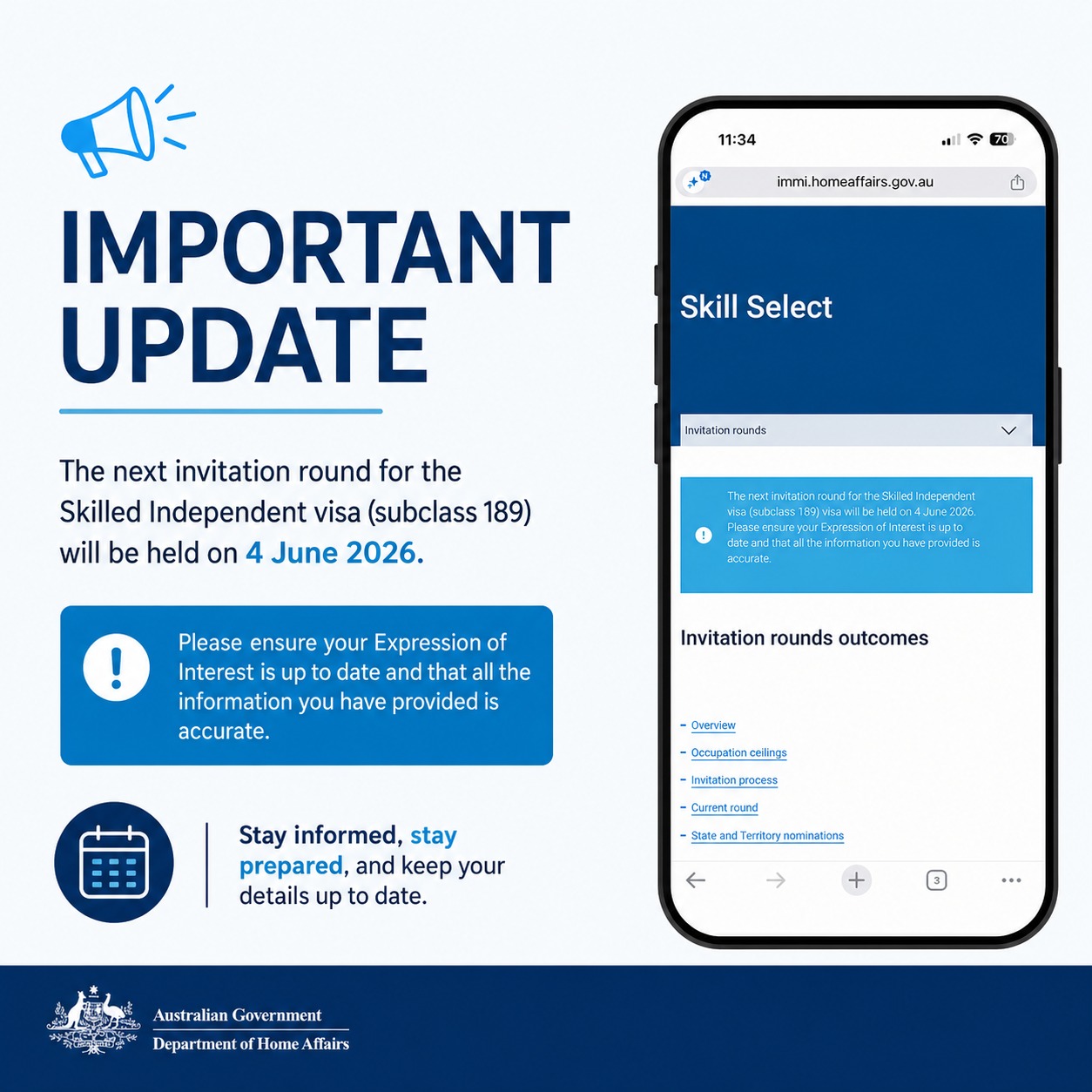
The 4 June 2026 SkillSelect 189 Round: What Was Invited and What to Do Next
The Department of Home Affairs ran an invitation round for the Skilled Independent (subclass 189) visa on Thursday 4 June 2026. The round has now taken place, and early reports suggest it leaned heavily toward healthcare. Below is what those early reports indicate was invited, followed by the EOI checklist that still decides your result in every round to come.
This was a major round of the 2025-26 program year and it carried real weight. The Department has moved from frequent monthly rounds to a smaller number of larger, more targeted ones, so each round now decides invitations for a much bigger group of candidates. For Africans and Nigerians with a 189-eligible profile, this is a round worth understanding closely.
Update, 4 June 2026: What This Round Invited (Early Reports)
In the hours after a round, the official figures are not published yet, so the picture below comes from early reports shared by Australian migration agencies based on the invitations their own clients received. Treat these as indicative only. The official numbers, including the exact minimum points per occupation, are published by the Department of Home Affairs on its SkillSelect previous-rounds page, and that is the figure to rely on.
What the early reports suggest:
- •This was a healthcare-heavy round. A large share of reported invitations went to health and care occupations, including Registered Nurses, General Practitioners, and Physiotherapists.
- •Other occupations also received invitations, including Social Workers, Secondary School Teachers, and Solicitors.
- •Points appear to vary widely by occupation. Some in-demand health and social-work profiles were reportedly invited from around the mid-70s, while more crowded fields such as general professional and ICT occupations are reportedly sitting much higher, around the mid-90s. Trade occupations continue to be invited closer to the 65-point minimum.
Two things to take from this if you are an African or Nigerian professional:
- 1.If you are in healthcare or social work, this round is encouraging. These fields were well represented, so your indicative points may be more competitive than you assumed. It is worth getting a clear read on where your profile actually stands.
- 2.If you are in a general professional or ICT occupation, the bar appears high. A score near the minimum is unlikely to be invited for 189 right now, which makes state nomination (subclass 190) or a regional pathway (subclass 491) the more realistic route to explore.
None of this is a guarantee of an outcome, and the official Home Affairs results take precedence over any early report. If you want a clear, personalised read on which pathway is worth exploring for your profile, that is exactly what the Afrovo team and our MARA-partnered registered migration agents help you work out.
Here is what still matters for every round, including the next one.
Your Pre-Round EOI Checklist
The Department invites candidates based on the exact state of their EOI on the round date. Anything you forget to update, anything you cannot evidence, and anything you got wrong cannot be fixed after invitations go out. Use the lead-up to any round to work through the following.
1. Verify every points claim against your evidence
Open each category in your EOI and confirm you have current, verifiable documents for it:
- •Age: your date of birth as listed.
- •English: your test result, still within validity (IELTS, PTE, and TOEFL are typically valid for three years).
- •Skilled employment: dated reference letters from each employer, on letterhead, with detailed duties that match your ANZSCO occupation.
- •Qualifications: your skills assessment outcome, still valid (most assessments are valid for three years).
- •Australian study, partner, or state nomination claims: documentary evidence to back each one.
If you claim points you cannot evidence, the visa application that follows the invitation will be refused. The cost of an incorrect claim is not just one lost round; it is wasted application fees and a refusal on your record.
2. Refresh anything that has lapsed
If your English test or skills assessment expired between when you submitted your EOI and now, your points claim is no longer supported. Either update before Thursday or accept that you will be ranked on a profile you can no longer prove.
3. Update your occupation, location, and family details if they have changed
Promotions, role changes, partner status changes, or moves between Australian states can all affect your claim. Your EOI must reflect your current circumstances on the round date, not the situation you were in when you first submitted.
4. Check your occupation against the latest CSOL
The Core Skills Occupation List (CSOL) replaced the older MLTSSL, STSOL, and ROL lists on 1 July 2023. Confirm your ANZSCO occupation is still eligible for subclass 189. If it has moved off the list, your EOI may no longer be invitable for 189 and you should be looking at subclass 190 or 491 alternatives instead.
5. Sense-check your total points against recent cut-offs
Recent subclass 189 rounds have invited candidates well above the 65-point minimum, and the cut-off varies by occupation. If your total points are close to the minimum, the realistic expectation is that you will not be invited in this round and that state nomination (190) or regional sponsorship (491) is the more credible path. Knowing this now lets you start the right work this week instead of waiting and hoping.
What the Round Will Publish
A few days after Thursday, the Department publishes:
- •The number of invitations issued for subclass 189.
- •The minimum points score that received an invitation.
- •The cut-off date and time, which serves as the tie-breaker when candidates share the same score.
This is the data you want. The minimum points figure is the single most useful number for planning what comes next. If it climbs again, the bar is rising and state nomination becomes more attractive. If it holds steady or eases for your occupation, your profile may be stronger than you thought.
If You Are Invited
You have 60 days from the date of invitation to lodge a complete visa application with the Department. That window goes quickly. Health checks, police clearances from every country you have lived in for 12 months or more in the last 10 years, and current evidence for every points claim all take real time. Start the day the invitation lands.
This is also the moment to bring a registered MARA migration agent into the process if you have not already. A visa application lodged on the back of an invitation is a formal migration matter, and the Afrovo team works alongside our MARA-partnered registered migration agents to make sure your application is structured correctly and lodged on time.
If You Are Not Invited
Sitting out this round is not the end of the road. It is information. The published cut-off tells you, in real numbers, where you sit against the rest of the pool. Use it to decide:
- •Whether to lift your points (a higher English score, more skilled experience, a partner skills assessment, the Professional Year program).
- •Whether to pursue state nomination (subclass 190) for the 5-point boost and state-specific selection criteria.
- •Whether to look at regional pathways (subclass 491) for the 15-point boost. Not sure which fits? Compare them in our 189 vs 190 vs 491 guide.
- •Whether your occupation is realistically being invited at all this program year.
Your EOI stays in the pool for the next round automatically, so you do not need to resubmit. But you do need to keep it current and accurate for every round that follows.
Related guides
Ready to Start Your Australian Journey?
Message our AI bot on WhatsApp for a free, personalised visa assessment.
Book Free Consultation